


AI Video Editing: Optimize Your Creative Workflow
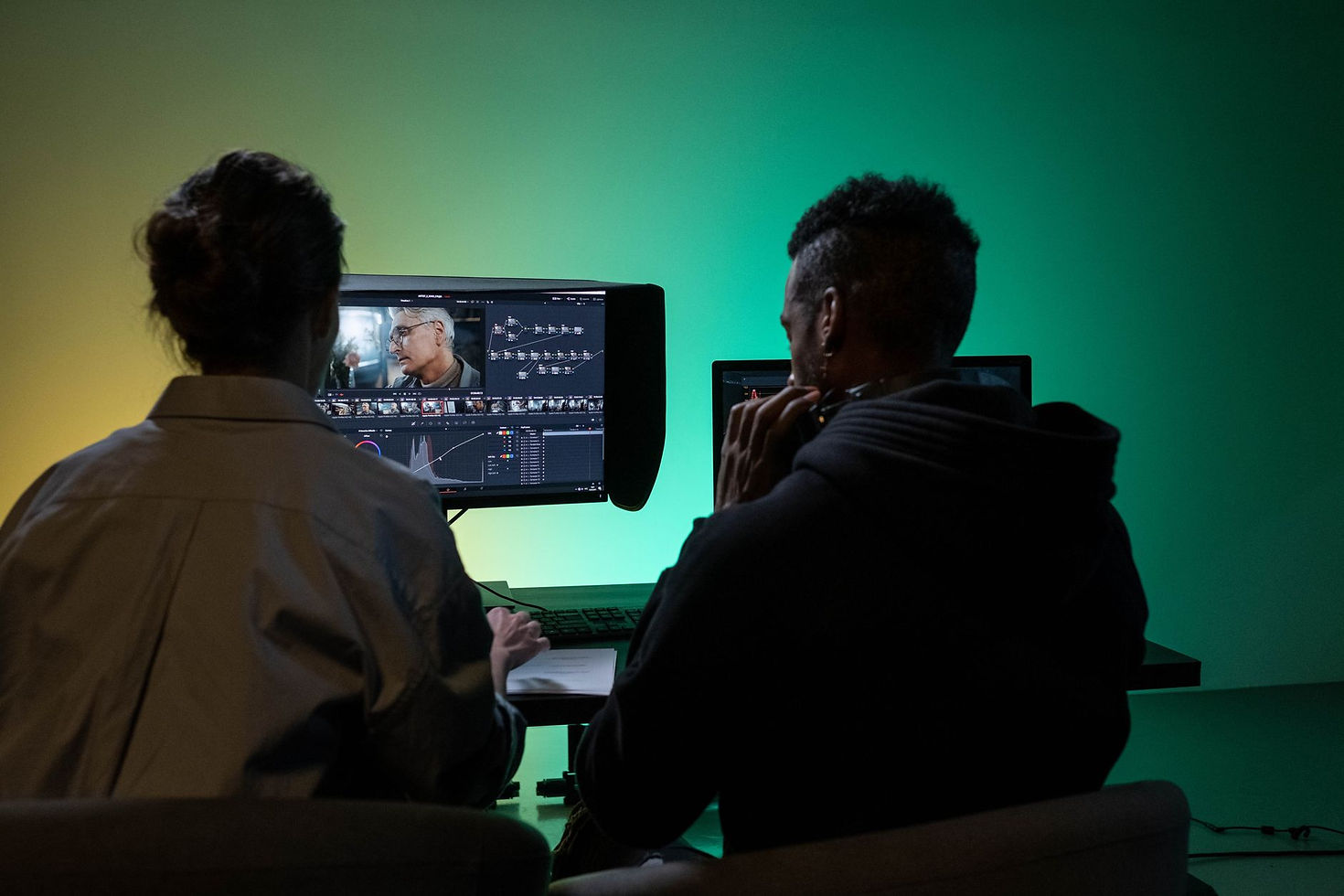
Artificial Intelligence has transitioned from a futuristic concept to an indispensable partner on set and in editing suites. For us at Bendita Filmes, who have been involved in audiovisual production since 2010, witnessing and integrating this evolution into our projects has been a game-changer. Video editing, once a frequently arduous and time-consuming process, now benefits from automations and insights that allow us to focus on what truly matters: narrative and creativity. If you want to understand how AI is redefining post-production and which tools are essential for your daily work, this guide is for you.

Foto de Vito Goričan no Pexels
The Impact of AI in Editing: Beyond Automation, a New Creative Logic
The significant advantage of AI in video editing, as we've seen in practice, isn't just about replacing the human editor but empowering them. AI now operates intelligently on multiple fronts, from raw footage triage to platform-specific optimization. Tasks that once consumed hours, like audio-video synchronization, identifying top-performing takes, or noise reduction, can now be completed in minutes. This frees us up for experimentation and the pursuit of more creative solutions, which would be unfeasible with purely manual methods.
Automating the Initial Process: Triage and Rough Cuts
For us, a historical bottleneck in production is handling raw footage. In large-scale projects, such as documentaries or institutional campaigns with many hours of filming, footage review can take weeks. AI tools, whether integrated or standalone, can analyze content and suggest the best moments based on criteria we define. For example, in a recent documentary project, we used AI to identify scenes with clear dialogue and strong facial expressions across over 30 hours of footage. The result was an initial rough cut in less than a day, which would have taken at least a week of intensive work from a junior editor without AI. The caveat here is that AI still doesn't replace the editor's discerning eye for subtle nuances or intentions beyond the obvious; it delivers a solid foundation, and the editor refines it.
Optimizing for Platforms and Formats with AI
The need to adapt content for various formats – from cinema to social media – is a constant challenge. In 2026, AI tools have become masters at this. 'Auto Reframe' (like Adobe's feature) is a classic example we use to adapt horizontal video for vertical formats like Stories or Reels, keeping the focus on the main action. What's often overlooked is that this automation requires fine-tuning. AI might not correctly identify the point of interest in a complex action scene, for instance, necessitating manual intervention. A trade-off we've learned is that the more automated a process, the more human review it requires.
Refreshing the Editor's Experience: Tools and Our Vision at Bendita Filmes
At Bendita Filmes, we continuously invest in solutions that add real value to our creative process. Our AI-powered video editing toolkit includes:
Integrated Platforms (Adobe Premiere Pro): Adobe's Sensei AI is a powerful ally. Features like 'Speech to Text' for automatic transcription are essential for our documentary workflow. 'Remix' helps us adjust soundtracks to the exact duration of a cut, saving rendering time and manual audio edits. The metric we track is the reduction in time spent on these specific tasks, averaging about 30% in projects where we strategically apply these features.
Specialized Tools (Descript): For more dynamic, voice-centric content like quick educational videos or webinars, Descript has revolutionized our editing. Text-based editing, removal of filler words, and ease of export are key strengths. A case in point: we created a series of short explainer videos for a client, and Descript allowed us to deliver over 15 videos in 5 business days, something unthinkable before AI. The drawback is that fine-grained visual editing control can be more limited compared to dedicated editing software.
New Frontiers (Runway ML and HeyGen): We are actively exploring tools like Runway ML for text-to-video generation experiments and HeyGen for creating avatars in explainer videos, especially for multilingual content. A practical example is using HeyGen to generate Spanish versions of an institutional video, using an avatar that speaks the language fluently. This allows us to serve international clients more agilely. The nuance here is the need for rigorous human review to ensure the message and emotion are conveyed correctly, as AI can still falter in cultural subtleties.
Nuances and Trade-offs in Implementing AI in Editing
It's crucial to understand that AI isn't a magic wand but a powerful tool that requires human intelligence to be used to its fullest potential. Beginners often fall into the trap of believing AI will solve all editing problems, ignoring the need for good planning and a critical eye. A common mistake is blindly trusting AI suggestions without review, leading to poorly made cuts or a confusing narrative. For instance, 'Scene Edit Detection' on a 30-second clip with very fast cuts might not identify all transitions correctly, requiring detailed manual checking.
Creative Decisions with AI: Where the Human Element Remains Essential
In today's landscape, AI is fantastic for repetitive tasks and generating suggestions. However, the final decision on a film's pacing, choosing music that evokes a specific emotion, or building a narrative climax still falls within the domain of the experienced editor. In a recent short fiction film project, AI helped us select the best acting takes, but the decision about which take conveyed the exact nuance of melancholy we were looking for was entirely human. The trade-off here is that AI can accelerate the discovery process, but the soul of the project resides in the creator's sensitivity.
AI for Small Projects vs. Large Productions
For small projects or independent creators, more accessible, automation-focused tools offered by online platforms are ideal for democratizing quality video production. For production companies like Bendita Filmes, dealing with larger and more complex productions, integrating AI into professional software (like Adobe's or DaVinci Resolve) and using more robust tools is strategic. The implementation cost and learning curve are higher in large productions, but the return in efficiency and the possibility of exploring new visual languages justify the investment. An example: for a large corporate client, we used AI to generate variations of the same institutional video with customized subtitles and calls to action, something that would be unfeasible at scale without AI.
Conclusion: Embracing the Future of Video Editing with Intelligence
Artificial Intelligence is transforming video editing, offering significant gains in efficiency, scalability, and new creative possibilities. At Bendita Filmes, we embrace this technology not as a replacement but as a powerful tool to enhance our work and deliver high-quality content. The key to success lies in understanding the nuances, trade-offs, and applying AI strategically, always with the critical eye and sensitivity of the human editor in charge.
Next Steps: Explore AI tools that align with your projects. Start with automation and transcription features in software you already use, and gradually experiment with more advanced platforms. Keep up with market innovations, as AI is evolving at a rapid pace. And remember: the best edit serves the story you want to tell.
About Bendita Filmes
Bendita Filmes is a full-service video production company and agency based in São Paulo, Brazil, specializing in:
Corporate Videos · YouTube Production · Instagram & TikTok · Advertising Campaigns · Event Filming · VFX & Animation · Live Streaming · AI Video Production · Photography


